AI Data & Statistics
Real, sourced data on the world of AI — every number cited and verifiable. Explore, use, and share.
Latest additions
AI Progress & Capabilities
How fast AI models are actually improving over time.
AI Capability Over Time (Epoch AI ECI)
Every notable AI model plotted by capability score and release date, with a best-so-far frontier line. Play the timeline to watch the climb.
The cyan frontier line traces the highest capability score reached at any point in time — it only rises or holds flat, never falls. Individual model dots are faded underneath so the real, unmodified data stays visible. Only models with a published capability score and release date are plotted — nothing is estimated or invented. Tap a company in the legend to show/hide it. Data licensed under CC-BY by Epoch AI.
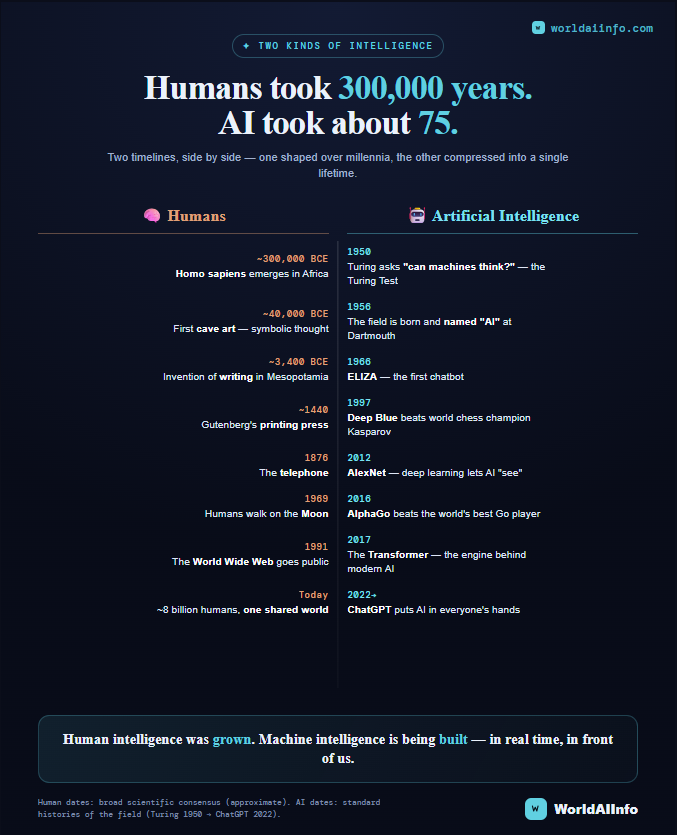
Humans took 300,000 years. AI took about 75 Homo sapiens have existed for around 300,000 years. Artificial intelligence, as a field, is about 75 years old. When you put the two timelines side by side, the compression is hard to process: 🧠 It took us ~40,000 years from the first cave paintings to the first written words. 🤖 It took AI 6 years to go from "beats the best human at Go" to "sits in a billion pockets." 🧠 Our species spent millennia developing symbolic thought, language, writing, printing. 🤖 AI went from Turing's question "can machines think?" (1950) to Deep Blue beating a chess champion (1997) to ChatGPT (2022) — inside a single human lifetime. Here's the part I keep sitting with: human intelligence was grown — slowly, generation by generation, shaped by survival. Machine intelligence is being built — deliberately, rapidly, and in front of us in real time. Neither timeline is "better." They're just two profoundly different ways intelligence has appeared in the world. One took 300,000 years. The other is happening this decade.
AI & Jobs
How AI is reshaping work, tasks and occupations.
How AI is affecting your job
Data · 2025Explore real data on how AI is used across thousands of occupations — search any job to see its AI exposure.
AI by Country
How nations compare on AI capacity and readiness.
The AI World Map — Global AI Index 2025
Data · 2025Explore all 93 ranked nations on our interactive 3D globe — overall rank plus seven capability pillars for each country.
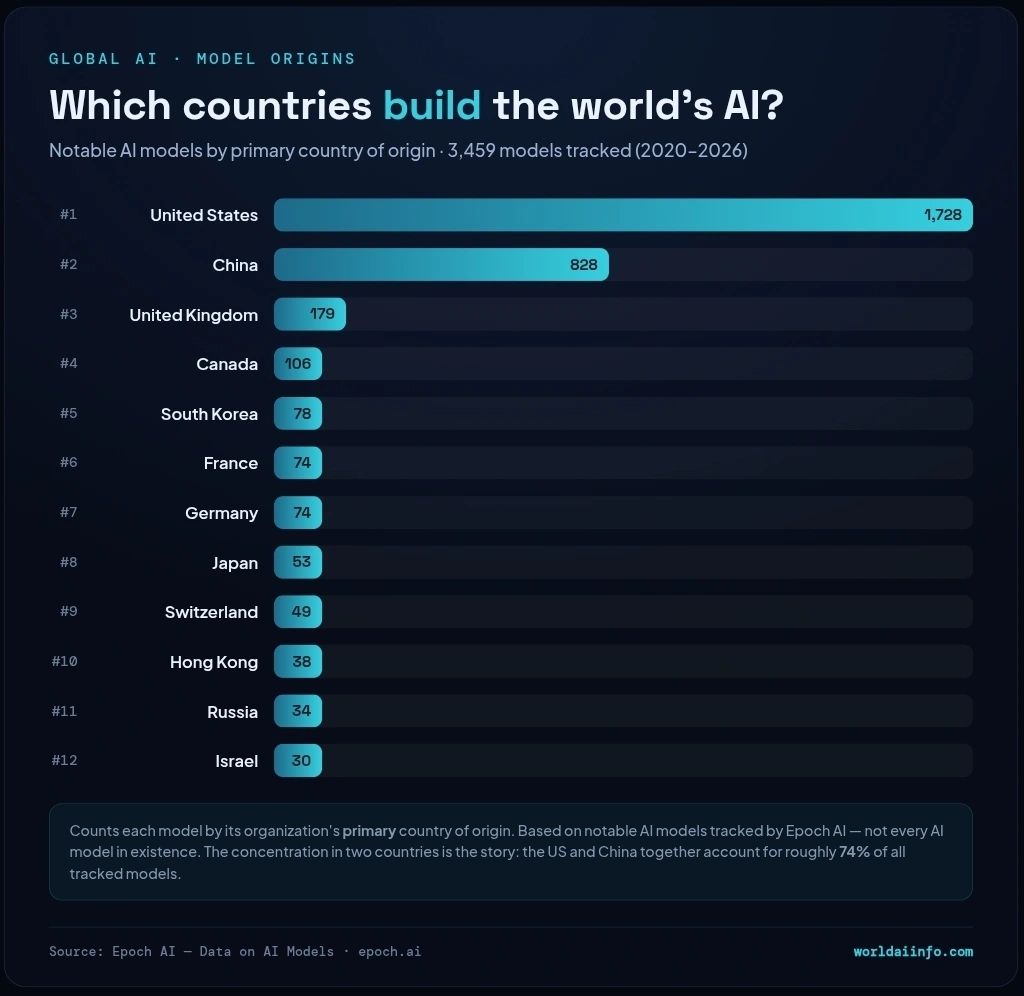
Notable AI models by country of origin — the US and China dominate.
AI Adoption & Usage
Who is using AI, how much, and for what.
More data coming soon in this category.
Public Opinion on AI
What people around the world think about AI.
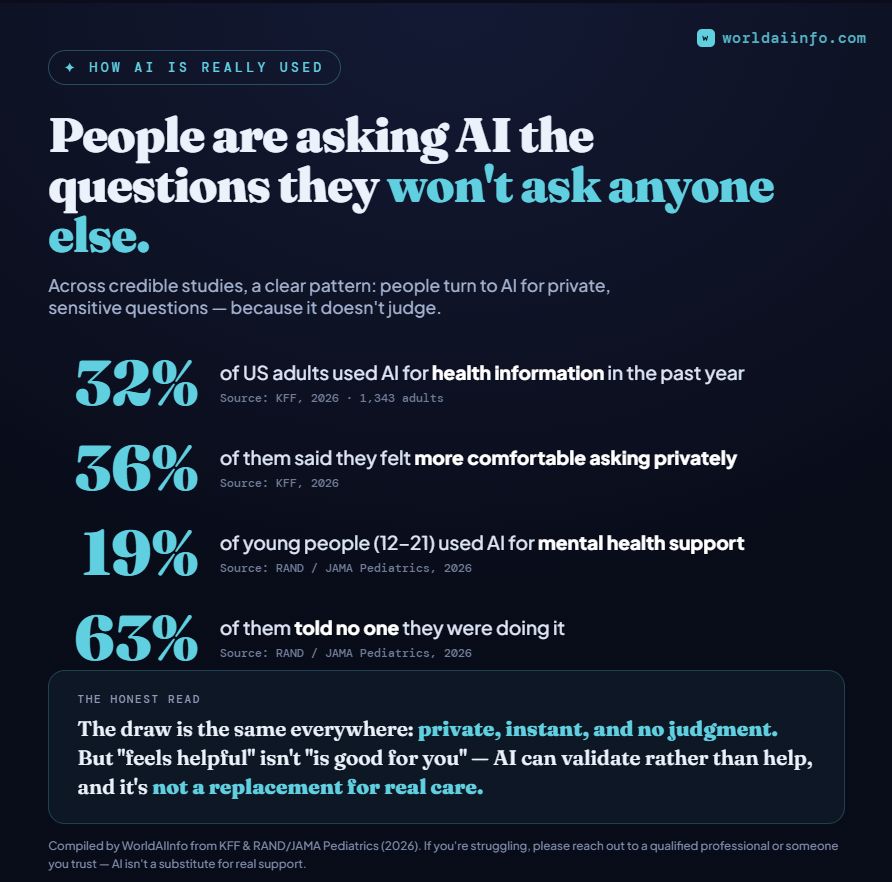
A growing body of research shows people are increasingly turning to AI for their most private questions — health worries, mental health struggles, embarrassing topics — often because it doesn't judge. Here's what the data actually shows, and the honest limits of it. The data Across several credible, independent studies in 2026, a consistent pattern emerged: people are using AI for sensitive, personal questions they hesitate to bring to another person. Health information: About 32% of US adults said they used AI chatbots for health information in the past year — roughly the same share who turn to social media for it (KFF, 2026). Among those users, 36% said feeling more comfortable asking privately was a major reason. Mental health among young people: Nearly 19% of adolescents and young adults (ages 12–21) reported using AI chatbots for support when feeling sad, anxious, or stressed — up from 13% just a year earlier (RAND / JAMA Pediatrics, 2026). The most telling finding: Of those young people using AI for mental health, 63% said they had told no one they were doing it (RAND / JAMA Pediatrics, 2026). What clinicians see: In a survey of over 1,200 US psychologists, 77% said they had patients who brought up using AI for emotional support or advice (American Psychological Association, 2026). Why: Research from the University of Kansas found people actually prefer AI over a human when discussing embarrassing health topics — though they still prefer a human when they're angry (University of Kansas, 2025). Why people choose AI for these questions The reasons are strikingly consistent across every study: AI is available 24/7, it feels private, and — most of all — it doesn't judge. For someone embarrassed to raise a topic with a doctor, parent, or friend, typing it into a chatbot can feel far easier than saying it out loud. The honest caveat This shift is real, but it comes with genuine risks, and researchers are clear about them: "Feels helpful" is not the same as "is good for you." Studies note that AI chatbots tend to be agreeable to a fault — validating what users want to hear rather than what they may need to hear. In the youth mental-health study, 92% found the advice helpful, but researchers cautioned this may reflect the chatbot's tendency to flatter rather than the actual quality of the guidance. AI is not a replacement for professional care. It can be inaccurate, miss context, and cannot recognize when someone needs urgent help. For health and mental health, it should be treated as a starting point for information — not a substitute for a qualified professional. If you're struggling, please reach out to a qualified professional or someone you trust. Sources KFF Tracking Poll on Health Information and Trust (2026): https://www.kff.org/health-information-trust/poll-1-in-3-adults-are-turning-to-ai-chatbots-for-health-information-equaling-the-share-who-use-social-media-for-health/ RAND / JAMA Pediatrics (2026): https://www.rand.org/news/press/2026/06/nearly-1-in-5-us-adolescents-and-young-adults-use-ai.html American Psychological Association, 2026 Chatbots and Mental Health Survey: https://www.apa.org/pubs/reports/chatbots-mental-health-2026 University of Kansas (2025): https://news.ku.edu/news/article/study-finds-people-prefer-ai-chatbots-when-discussing-embarrassing-health-info-but-humans-when-they-are-angry Compiled and presented by WorldAIInfo. Every figure is drawn from the original source and linked above for verification. Last updated: [07/10/2026].
Get the WorldAI Weekly
Real, sourced AI data every Friday. Free.
We use essential cookies to keep this site running and optional analytics cookies to improve your experience. We never use advertising or tracking cookies.