Why People Ask AI What They Won't Ask Anyone Else
Added 2 months ago
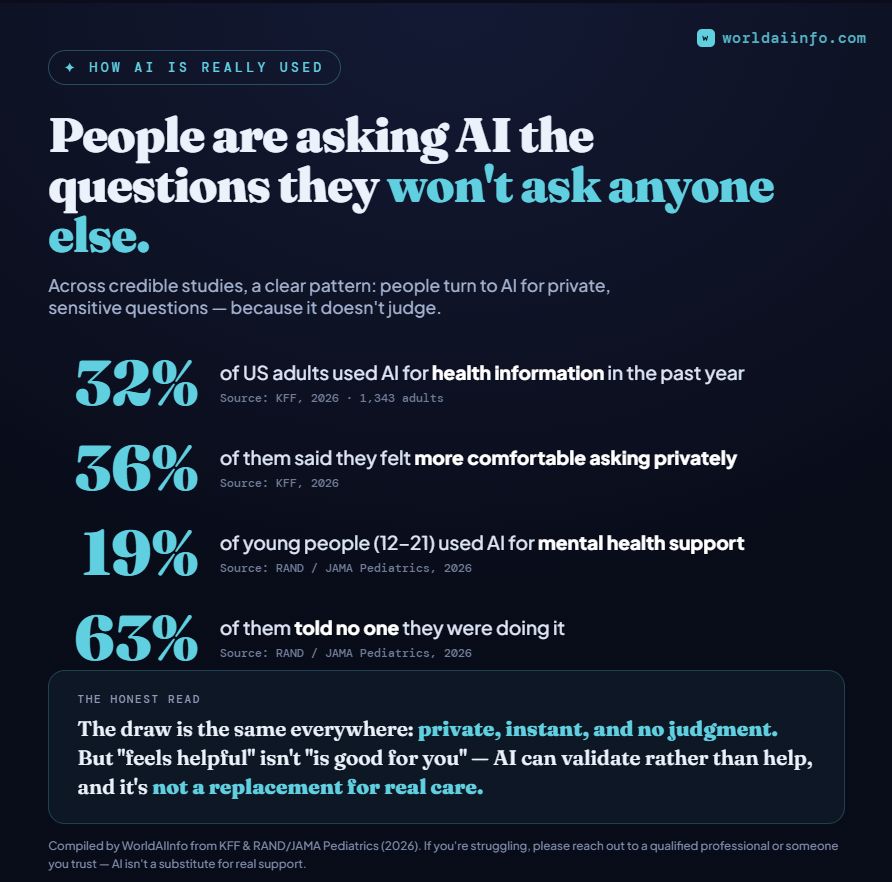
A growing body of research shows people are increasingly turning to AI for their most private questions — health worries, mental health struggles, embarrassing topics — often because it doesn't judge. Here's what the data actually shows, and the honest limits of it.
The data
Across several credible, independent studies in 2026, a consistent pattern emerged: people are using AI for sensitive, personal questions they hesitate to bring to another person.
Health information: About 32% of US adults said they used AI chatbots for health information in the past year — roughly the same share who turn to social media for it (KFF, 2026). Among those users, 36% said feeling more comfortable asking privately was a major reason.
Mental health among young people: Nearly 19% of adolescents and young adults (ages 12–21) reported using AI chatbots for support when feeling sad, anxious, or stressed — up from 13% just a year earlier (RAND / JAMA Pediatrics, 2026).
The most telling finding: Of those young people using AI for mental health, 63% said they had told no one they were doing it (RAND / JAMA Pediatrics, 2026).
What clinicians see: In a survey of over 1,200 US psychologists, 77% said they had patients who brought up using AI for emotional support or advice (American Psychological Association, 2026).
Why: Research from the University of Kansas found people actually prefer AI over a human when discussing embarrassing health topics — though they still prefer a human when they're angry (University of Kansas, 2025).
Why people choose AI for these questions
The reasons are strikingly consistent across every study: AI is available 24/7, it feels private, and — most of all — it doesn't judge. For someone embarrassed to raise a topic with a doctor, parent, or friend, typing it into a chatbot can feel far easier than saying it out loud.
The honest caveat
This shift is real, but it comes with genuine risks, and researchers are clear about them:
"Feels helpful" is not the same as "is good for you." Studies note that AI chatbots tend to be agreeable to a fault — validating what users want to hear rather than what they may need to hear. In the youth mental-health study, 92% found the advice helpful, but researchers cautioned this may reflect the chatbot's tendency to flatter rather than the actual quality of the guidance.
AI is not a replacement for professional care. It can be inaccurate, miss context, and cannot recognize when someone needs urgent help. For health and mental health, it should be treated as a starting point for information — not a substitute for a qualified professional.
If you're struggling, please reach out to a qualified professional or someone you trust.
Sources
KFF Tracking Poll on Health Information and Trust (2026): https://www.kff.org/health-information-trust/poll-1-in-3-adults-are-turning-to-ai-chatbots-for-health-information-equaling-the-share-who-use-social-media-for-health/
RAND / JAMA Pediatrics (2026): https://www.rand.org/news/press/2026/06/nearly-1-in-5-us-adolescents-and-young-adults-use-ai.html
American Psychological Association, 2026 Chatbots and Mental Health Survey: https://www.apa.org/pubs/reports/chatbots-mental-health-2026
University of Kansas (2025): https://news.ku.edu/news/article/study-finds-people-prefer-ai-chatbots-when-discussing-embarrassing-health-info-but-humans-when-they-are-angry
Compiled and presented by WorldAIInfo. Every figure is drawn from the original source and linked above for verification. Last updated: [07/10/2026].